Do I Need Bear Spray In Bryce Canyon?
Bear spray is not among the precautions the park service lists for Bryce Canyon. Here is what the official guidance actually warns about, and how the park's altitude, weather and trail closures shape a safe visit.
No, bear spray is not a precaution the park service lists for Bryce Canyon. The official guidance for this park focuses elsewhere: elevations average about 8,000 feet with trails reaching 9,115 feet, summer afternoons bring frequent thunderstorms and lightning, and October snowstorms are described as not unusual. This article works through what the park actually warns about.
Visitors packing for southern Utah often tuck a can of bear spray into the duffel out of habit, usually carried over from trips to Glacier or Yellowstone, and then wonder whether it will do anything at Bryce. The park's own planning pages do not include bear spray among the precautions for a Bryce visit. That is not an oversight. The park service's day-hike guidance for Bryce Canyon centers on altitude, water, traction and weather, and its conditions page tracks mud, rockfall and storm closures rather than wildlife encounters.
That does not make the park risk-free. It means the risks here have a different shape than the ones bear spray answers. Bryce Canyon sits high on the Paunsaugunt Plateau, its famous Amphitheater of hoodoos reachable by trails that begin with a descent, which makes every return leg an uphill climb in air that carries roughly 75 percent of the oxygen available at sea level. The park service recommends drinking about one quart, roughly one liter, of water every one to two hours of hiking. That single line of guidance does more to keep visitors out of trouble than any canister in a backpack.
There is also a practical wrinkle worth naming early: bear spray is regulated on aircraft, and since most Bryce visitors arrive by way of Las Vegas or Salt Lake City, each about 270 miles from the park, a can that cannot fly often gets abandoned in a rental car or a hotel bin before the trip home. Leaving it out of the packing list entirely simplifies the logistics as well as the safety question.
For travelers who prefer to have a guide handling the route-finding, the pacing and the water, several bookable options cover the Amphitheater. The 3-hour small group park tour run by Bryce Canyon Scenic Tours moves through the main viewpoints with water and snacks included, and a longer guided sightseeing version from the same operator starts in Fairyland Canyon and folds in the park entrance fee. There is also a private guided hike with picnic that descends into the Amphitheater itself. We compared the listings below.
What Hazards Does The Park Service Actually Warn About?
The park's stated hazards are altitude, lightning, dehydration, trail traction and storm closures. Ranger programs are cancelled when lightning is within 10 miles in summer, and when snowstorms or windchill of 10 degrees Fahrenheit or below arrive in winter. The conditions page reports mud, deteriorated backcountry sections and temporary road closures, not wildlife.
The park service's weather page is blunt about the pattern. The rainy season runs July and August, with frequent afternoon thunderstorms and lightning. Because the Amphitheater trails drop below the rim, hikers are exposed on open slopes with few places to shelter, so the guidance is to start early and be off exposed terrain by early afternoon. The same page notes that snowstorms in October are not unusual and that temperatures drop below freezing nearly every night from October through May.
Altitude is the second documented theme. Effective oxygen at 8,000 feet is about 75 percent of sea level, and the hiking page reminds visitors that Bryce trails begin with a descent, so every hike finishes uphill. The park service pairs that with the water recommendation and with advice to pace yourself, particularly if you have arrived from low elevation the same day. Las Vegas and Salt Lake City airports each sit about 270 miles away, which means many visitors drive up from much lower deserts and step onto a rim trail within hours. The Visitor Center itself stands at 7,894 feet, so even standing at the overlook is already a high-elevation activity by the standards of most American parks.
The third theme is trail condition. The park's current alerts, as published on its conditions page, report that the Wall Street section of the Navajo Loop is closed until further notice following recent rains, with other trails open but muddy. The Under-the-Rim backcountry trail has deteriorated sections, and the park service tells hikers to proceed at their own risk with strong wayfinding skills. None of these hazards is addressed by bear spray; all of them are addressed by checking alerts, wearing lug-soled shoes and turning back when conditions change.
A fourth theme runs quietly through the rules pages. All off-highway vehicles are prohibited on park roads and areas, drones may not launch or land inside the boundary, and fires are permitted only in established fire pits with fireworks prohibited outright. The park that documents its dangers this precisely would say so if a predator encounter belonged on the list.
How Does The High Altitude Change Your Hiking Plans?
Bryce Canyon averages about 8,000 feet and reaches 9,115 feet at its high points, with the Visitor Center at 7,894 feet. At 8,000 feet, effective oxygen is about 75 percent of sea level. The park service advises drinking roughly one quart per one to two hours of hiking and pacing the climb out of the canyon.
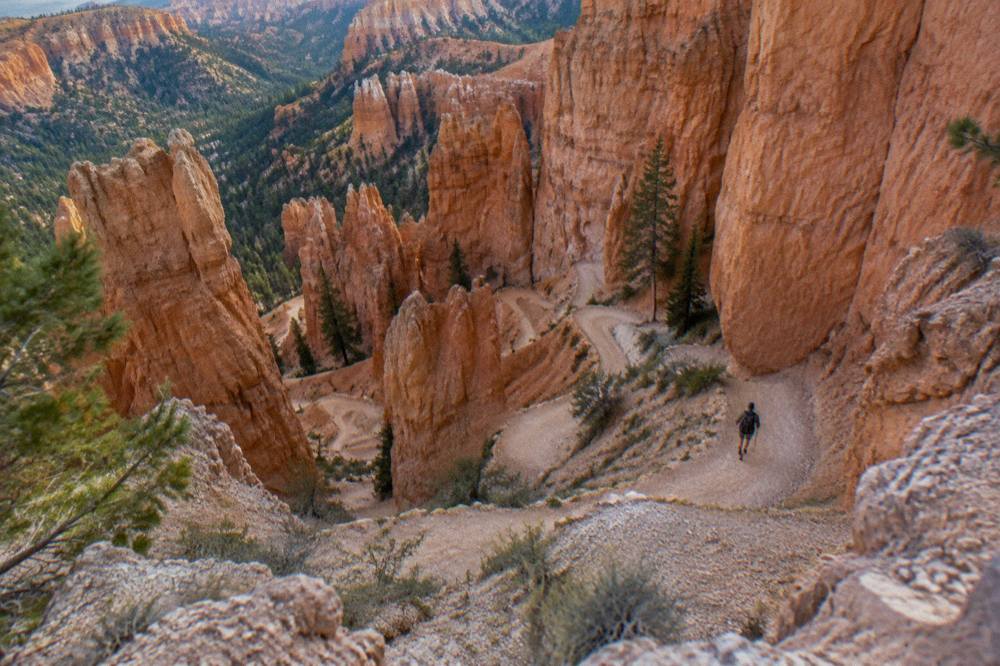
The altitude question is worth a section of its own because it surprises more visitors than any wildlife ever has. People arrive from Las Vegas, about 270 miles away, or from Zion's east entrance 78 miles away, and underestimate how quickly the air thins. The descent into the Amphitheater feels easy. The ascent back to the rim, one switchback at a time under a high desert sun, is where unprepared hikers run out of steam, and the park service's day-hike guidance says so directly.
Symptoms the park and its rangers describe in thin-air country are familiar ones: shortness of breath on gentle grades, headaches in the first day or two, and unusual fatigue on what looked like a short walk on the map. The remedies are pace, water and an honest first day. Build the rim walk and one short descent into day one, save longer routes such as the Peekaboo Loop for later in the trip, and carry more water than feels reasonable. The Queen's Garden and Navajo combination loop is the route the park itself recommends most for first-timers: descend Queen's Garden from Sunrise Point, climb the Navajo Loop back to Sunset Point, and return along the Rim Trail. Note that the Wall Street section of that Navajo leg is closed until further notice per the park's alert, so the slot-canyon portion of the loop is off the table for now.
A guided option shifts some of that load. The guided sightseeing tour of Bryce Canyon National Park, from $109 per person and rated 4.9 across 945 reviews, runs three hours by minivan through Fairyland Canyon, the Natural Bridge, Inspiration Point and the Cathedral, with the park entrance fee, water, snacks and umbrellas included. It is a drive-and-stand experience rather than a hike, which suits visitors who want the geology without the uphill finish, and it works for travelers whose knees or lungs would rather not argue with 8,000 feet of elevation on a switchback trail.
Which Bryce Canyon Trails Are Closed Or Rough Right Now?
The Wall Street section of the Navajo Loop is closed until further notice following an NPS alert, and it is closed for the winter season by default in any case. Under-the-Rim has deteriorated sections that the park says hikers cross at their own risk. Other trails were open but muddy after recent rains.
Trail status at Bryce changes with the weather, so the park service's alerts page is the source to check the morning you hike. As of the park's late September alert, the rain-damaged Wall Street slot is shut, which removes the most dramatic, and most enclosed, stretch of the Navajo Loop from circulation. The rest of the Amphitheater network, Queen's Garden, the Navajo switchbacks to Sunset Point, and the connecting Rim Trail, remained open, with mud flagged as the nuisance of the week.
Winter adds its own pattern, described on the park's winter page. The Wall Street side of the Navajo Loop and the Rim Trail between Inspiration and Bryce Points close for the entire winter season. The Fairyland Point road, one mile, and the Paria View road, three tenths of a mile, close to vehicles so they can serve as ski routes. The main scenic drive can temporarily close at mile marker 3 after storms until plows clear the southern stretch, a closure the park says typically lasts a day or more, while the first three miles holding the Amphitheater viewpoints are prioritized for plowing. Snow levels near the Visitor Center run about half of what accumulates at Agua Canyon, nearly 1,000 feet higher, so conditions can differ sharply between the rim and the southern drive on the same morning.
One genuinely fresh change cuts the other way. The final 2.7-mile segment of the Shared Use Path, the paved Canyon2Canyon Trail, was completed in autumn 2026, connecting the Visitor Center, the Sunrise, Sunset, Inspiration and Bryce Point area, the campgrounds and Red Canyon along a route open to pedestrians and cyclists. Bicycles and e-bikes are permitted on park roads and this path only, not on the Rim Trail or overlooks. For families and visitors who want flat walking above the rim, it is now the most forgiving long stretch of ground in the park.
Do Guided Tours Change The Safety Picture?
Yes, in specific ways. The full-day hike listings include a medically trained, naturalist guide, and the private hike with picnic adds trekking poles, lunch and snacks. Guides carry route knowledge through closures and mud. Every in-park tour on this roster lists free cancellation, and none replaces water and traction.
A guide does not repeal the altitude or the lightning, but the listings show what they do add. Good Trip Adventures runs a full-day small group tour and hike from $427 per person, six to eight hours, with a medically trained, naturalist guide, snacks and park entry fees included, and a private full-day version with lunch added from $972.95 per person. Cedar & Sage Boutique Trekking's private guided hike and picnic, from $699 per group for up to four people and rated 5.0 across 33 reviews, covers the Queens Garden Loop, Sunrise Point, Sunset Point and Thor's Hammer with trekking poles, lunch, snacks and water supplied. On a trail network where the headline hazard is a demanding uphill return at elevation, a guide who sets the pace and carries the plan is a real safety asset.
The shorter scenic tours serve a different visitor. The Scenic Tour of Bryce Canyon, from $84.81 per person and rated 4.9 across 1,215 reviews, is a three-hour small group circuit of the park's overlooks with bottled water and snacks, meeting at 450 N Arpt Rd in Bryce Canyon City. The listing excludes the park admission fee, so bring your entrance receipt or pass. For seniors and families weighing whether a guided format beats a self-drive, our guide to choosing a Bryce Canyon tour walks through the trade-offs, and the 3-hour Scenic Tour of Bryce Canyon is the entry point most first-timers pick.
| Tour | Format | Duration | Price | Rating |
|---|---|---|---|---|
| Scenic Tour of Bryce Canyon | Small group park tour | 3 hours | From $84.81 per person | 4.9 from 1,215 reviews |
| Guided Sightseeing Tour (Fairyland start) | Small group park tour | 3 hours | From $109 per person | 4.9 from 945 reviews |
| Private Guided Hike & Picnic | Private hike | 4 to 6 hours | From $699 per group (up to 4) | 5.0 from 33 reviews |
| Full Day Small Group Tour & Hike | Small group hike | 6 to 8 hours | From $427 per person | 5.0 from 5 reviews |
| Bryce Canyon Private Tour | Private park tour | 3 hours | From $159.95 per person | 5.0 from 35 reviews |
What Should You Pack Instead Of Bear Spray?
Water, roughly one quart per one to two hours of hiking, lug-soled or traction footwear, layers for freezing nights from October through May, sun protection and a checked trail alert. Those items map directly to the park service's stated hazards. Bear spray answers a hazard the park does not document.
The packing list follows from the guidance. Water first, because the park service quantifies it and because dehydration plus altitude is the park's most common combination. Traction second, because mud now and ice later are the conditions the alerts actually describe; the Full Moon Hike requirements, lug-soled footwear and no flashlights, tell you what the park thinks of walking these rims in the dark. Layers third, because monthly average lows run from 15 degrees Fahrenheit in January to 53 in July, and because a July afternoon thunderstorm can drop the temperature fast on an exposed overlook. Sun protection fourth, because the high-desert sun at 8,000 feet burns through thin air faster than most visitors expect. A checked trail alert, read the morning you hike, rounds out the list.
The monthly averages are worth seeing in full, because they reframe the question. Bryce is a high desert with a winter: average snowfall at headquarters is roughly 100 inches per year, with historical monthly averages of 17 inches in January, 18 in February and 17 in March.
| Month | Average high (F) | Average low (F) | Typical snowfall (in) |
|---|---|---|---|
| January | 37 | 15 | 17 |
| February | 38 | 17 | 18 |
| March | 45 | 23 | 17 |
| April | 54 | 29 | 8 |
| July | 80 | 53 | 0 |
| October | 58 | 32 | varies |
| November | 45 | 23 | 10 |
| December | 36 | 15 | 14 |
Those numbers come from the park service's own weather page, and they carry a plain message: the "bear spray question" at Bryce is usually really a weather and footwear question. If you are visiting on a winter trip, our Bryce Canyon winter tours guide covers snowshoe hikes and cold-weather planning in detail, and winter full moon hikes become snowshoe hikes when snowpack passes 16 inches.
How Does Weather Shape The Real Risk At Bryce?
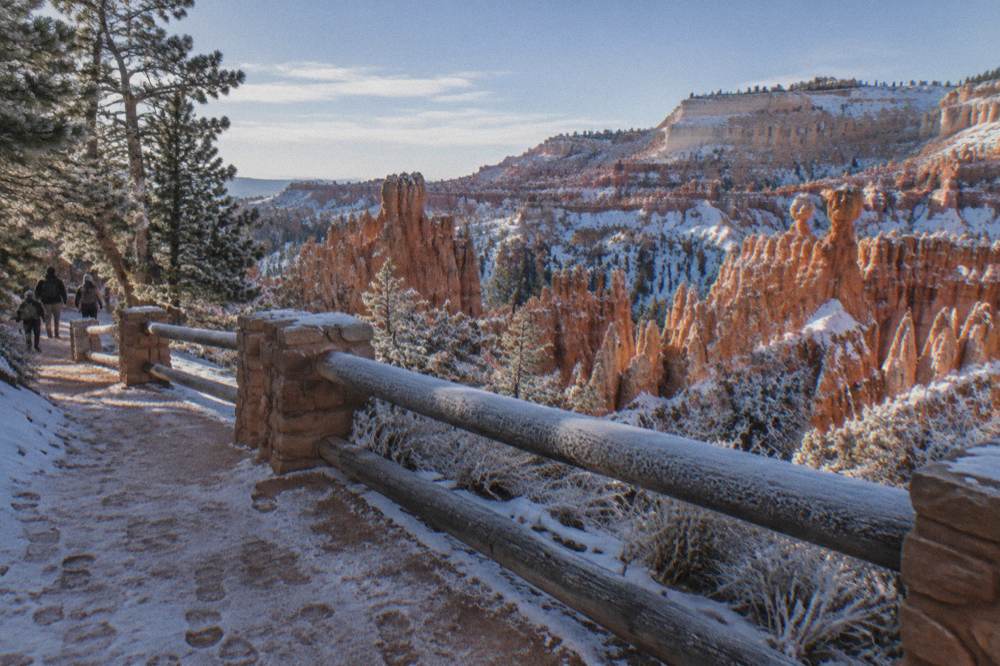
Summer risk is lightning and heat on exposed trails, with ranger programs cancelled when lightning is within 10 miles. Winter risk is cold, snow and road closures at mile marker 3 after storms. October sits between: snow is not unusual, and nights fall below freezing nearly every night.
The official numbers behind that summary come from the park service weather page, which lays out the monthly averages above plus the storm patterns. The day-hikes page covers the altitude, water and trail-descent guidance, and the current conditions page carries the live alerts, including the Wall Street closure. Between those three pages, the park has told you everything it considers worth warning you about, and bear spray is not on any of them.
Timing your visit around the hazards is the final practical step. The park's most popular months are May through September, which brings the shuttle season, the ranger astronomy programs and, in July and August, the afternoon storm cycle. The shuttle, free with admission and running roughly every 15 minutes, operates through mid-October in season, which helps with parking at the Amphitheater lots. Oversize vehicles, 23 feet and longer, are restricted from Amphitheater-area parking during shuttle season but face no restriction on the Southern Scenic Drive. For the full logistics picture, including the shared-use path and entrance fees, see our Bryce Canyon planning overview.
The sky at night deserves a place in the safety story too, in a positive sense. Bryce is an International Dark Sky Park with a Gold Tier designation, and roughly 100 astronomy programs run in a typical year, best near the new moon. A guided stargazing session at a private dark-sky site near Bryce Canyon City, from $59 per person with telescopes, guides and hot beverages, is a low-exertion way to enjoy the park's most famous after-dark asset, and it asks nothing of your lungs at all. This site, Bryce Canyon National Park Tours, keeps every figure on this page tied to the park service's published guidance and the live tour listings, so the safety advice holds even as the seasons turn.
Common Questions About Bear Spray At Bryce Canyon
Do I Need Bear Spray In Bryce Canyon?
No. Bear spray does not appear in the park service's safety guidance for Bryce Canyon. The documented hazards are altitude around 8,000 to 9,115 feet, afternoon lightning in July and August, freezing nights from October through May, and muddy or closed trail sections after storms.
What Is The Biggest Safety Risk At Bryce Canyon?
Altitude combined with dehydration. The park service states that effective oxygen at 8,000 feet is about 75 percent of sea level, that every trail starts with a descent so every return is uphill, and that hikers should drink about one quart of water every one to two hours.
Is Wall Street Open At Bryce Canyon?
No. The Wall Street section of the Navajo Loop is closed until further notice per a park service alert following recent rains, and it closes for the winter season by default. The park service's conditions page carries the current status.
Are There Ranger Programs If The Weather Turns?
Ranger programs run on a schedule posted at the Visitor Center but are weather-dependent. The park cancels them when lightning is within 10 miles in summer and during snowstorms or windchill of 10 degrees Fahrenheit or below in winter. About 100 astronomy programs run in a typical year.
Do Guided Tours At Bryce Handle Safety For You?
Partly. The full-day hike listings include a medically trained, naturalist guide, and the private hike and picnic supplies trekking poles, lunch and water. Guides manage pacing and route-finding through closures, but altitude and lightning remain every visitor's own responsibility.
What Footwear Does The Park Recommend?
Lug-soled shoes for traction. The park's mud and ice advisories, and its Full Moon Hike requirement of lug-traction footwear, point to grip as the recurring footwear concern on the Amphitheater trails.