What To Do In Bryce Canyon If You Don't Hike?
A research-backed guide to enjoying Bryce Canyon without hiking: rim viewpoints, the shuttle, a 3-hour scenic tour, horseback rides in Red Canyon, helicopter flights and stargazing sessions.
What To Do In Bryce Canyon If You Don't Hike?
You have more options than you might expect: the Bryce Amphitheater's main viewpoints sit a short walk from parking on the rim, the free shuttle covers the busiest 3 miles, and paid experiences include a 3-hour guided scenic tour from $84.81 per person, a Red Canyon horseback ride from $130, a 15-minute helicopter flight from $175, and stargazing sessions from $59. None of them require hiking below the rim.
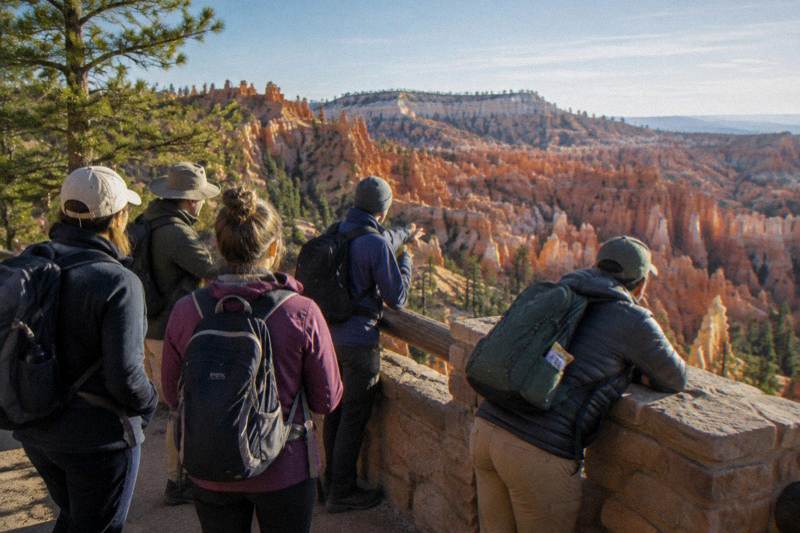
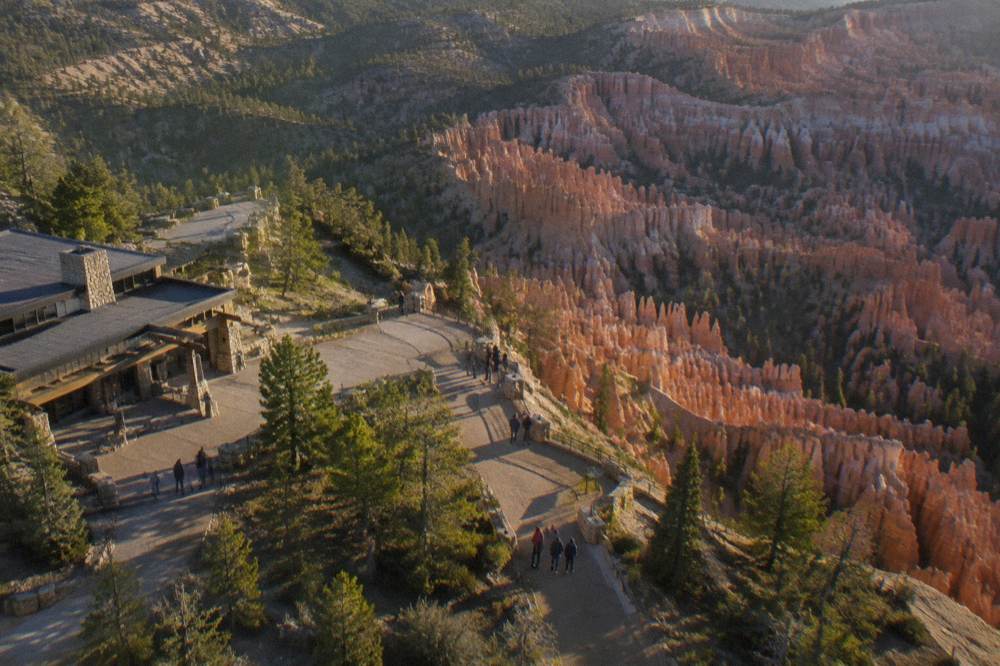
Bryce Canyon has a reputation as a hiker's park, and the famous trails, the Queen's Garden and Navajo Loop combinations, get the headlines. But the defining feature of this park is that its geometry works in your favor if you stay up top. The hoodoos of the Bryce Amphitheater stand below the rim, which means you look down on them from the edge rather than up at them from a valley floor. The overlooks at Sunrise, Sunset, Inspiration and Bryce Points deliver the postcard views from paved, mostly level walkways.
That single fact shapes everything in this article. We compared the listings on this site's tour roster and the National Park Service's own planning pages to build a non-hiker's itinerary, and the short version is that you can fill two full days without lacing up a boot. One practical note before anything else: the Wall Street section of the Navajo Loop has been closed until further notice since a park service alert on September 29, 2026, so even the hikers are rerouting this season. Non-hikers lose nothing by it.
Costs stay modest. Park entry runs $35 per private vehicle, and the shuttle, the ranger programs and the Shared Use Path are free with admission. The paid add-ons, an audio driving tour, a guided minivan tour, a ride or a flight, stack on top only where you want them.
See The Amphitheater From The Rim At Bryce Canyon
The four main overlooks, Sunrise, Sunset, Inspiration and Bryce Point, all sit within the first 3 miles of the park road, and each is reached by a short paved or graded walk from its parking area. The half-mile stretch of Rim Trail between Sunset and Sunrise Points is wheelchair accessible, and the National Park Service lists it as the only such section. You can see the full amphitheater without ever descending into it.
The amphitheater viewpoints cluster along miles 1 to 3 of the 18-mile main road, which is why the park prioritizes those miles for snow plowing in winter and why the shuttle route concentrates there in summer. Sunrise Point and Sunset Point face east and west respectively, so the naming is literal: the park service recommends Sunrise Point and Bryce Point for morning light, and Inspiration Point or Paria View about 1.5 hours before sunset for the evening show. Paria View looks south rather than into the main amphitheater, and it tends to be the quietest of the set.
Inspiration Point deserves a slow look. Its terrace sits at the amphitheater's edge with a direct line down onto the silent city of stone formations below, and the layered oranges and whites change character as clouds move. Bryce Point, the southernmost of the four, gives the widest single panorama, taking in the whole basin plus the Pink Cliffs beyond. Both are a few minutes' walk from drop-off points.
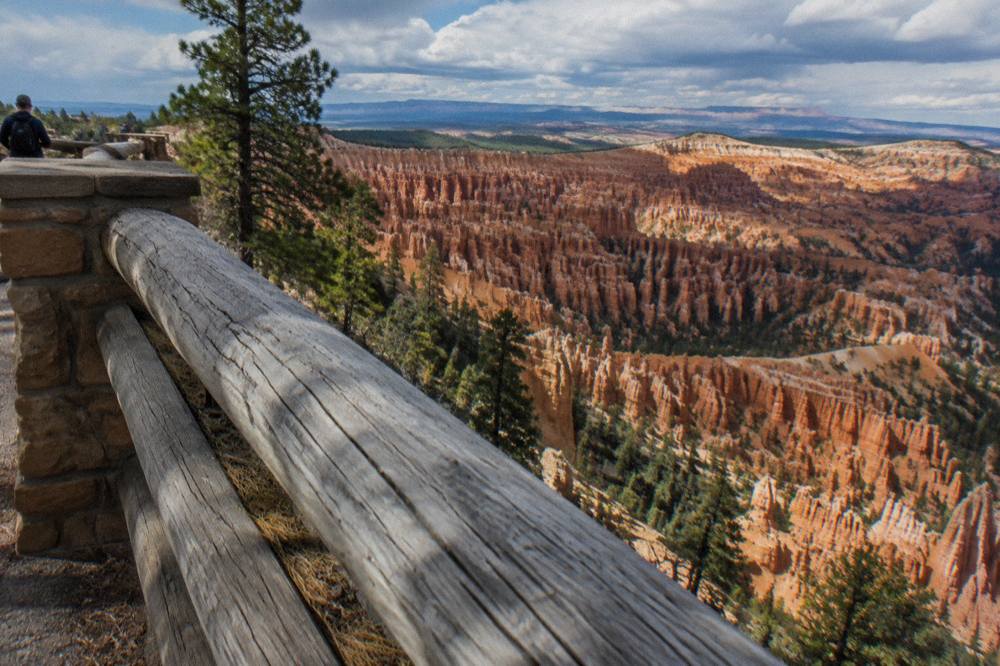
If walking even short distances is a concern, note that distances from parking to viewpoint are genuinely small at the big four, usually well under a quarter mile on gentle grades, but the ground is uneven gravel in places. The park's accessibility guidance is specific: only that half-mile Rim Trail segment between Sunset and Sunrise meets wheelchair standards, and the 1-mile Bristlecone Loop at Rainbow Point has a hard surface but grades steeper than accessibility standards allow. Read more in the park service's own day-hike and accessibility pages if pavement matters to your plans, and see this site's rundown of Bryce Canyon tours for seniors for pace-by-pace options.
A guided option pairs well with the rim walk. The Scenic Tour of Bryce Canyon, a 3-hour small group tour from Bryce Canyon City, runs from $84.81 per person and holds a 4.9 rating across 1,215 reviews; it drives the overlooks with a guide and includes water and snacks, with park admission separate. A sister version, the Guided Sightseeing Tour of Bryce Canyon National Park, starts in Fairyland Canyon and visits the Natural Bridge, Inspiration Point and the Cathedral from $109 per person, 4.9 across 945 reviews, and it includes the park entrance fee, a real difference for international visitors facing the nonresident charge.
| Viewpoint | Where it sits | What you see | Access notes |
|---|---|---|---|
| Sunrise Point | Mile 1 area, amphitheater north end | East-facing amphitheater at dawn | Paved path; wheelchair-accessible Rim Trail segment to Sunset Point |
| Sunset Point | Mile 1 to 2 area | Close-up hoodoos including Thor's Hammer | Short walk from parking; steps in places |
| Inspiration Point | Mile 1 to 3 area | Terrace view directly over the formations | Graded walk; some uneven ground |
| Bryce Point | Mile 1 to 3 area, southern end | Widest panorama of the whole basin | Short walk; exposed edge |
Take A Scenic Drive Or Ride The Bryce Canyon Shuttle
The 18-mile main road doubles as the park's best attraction for non-hikers: you can drive it end to end, stop at a dozen overlooks and never walk more than a few hundred feet. The free shuttle runs buses about every 15 minutes through mid-October, and oversize vehicles over 23 ft are restricted from amphitheater parking in shuttle season but not on the southern scenic drive.
Driving yourself is completely legitimate here. The park service confirms there is no timed entry and no reservation needed, and the southern half of the road, miles 4 to 18, carries far less traffic than the amphitheater. Natural Bridge, a natural arch carved through the rim, Agua Canyon and the overlooks at Rainbow and Yovimpa Points make the southern drive its own reward. Rainbow Point at the road's end sits at the top of the park's elevation range, and Yovimpa Point looks out over the Grand Staircase's layered steps toward Arizona.
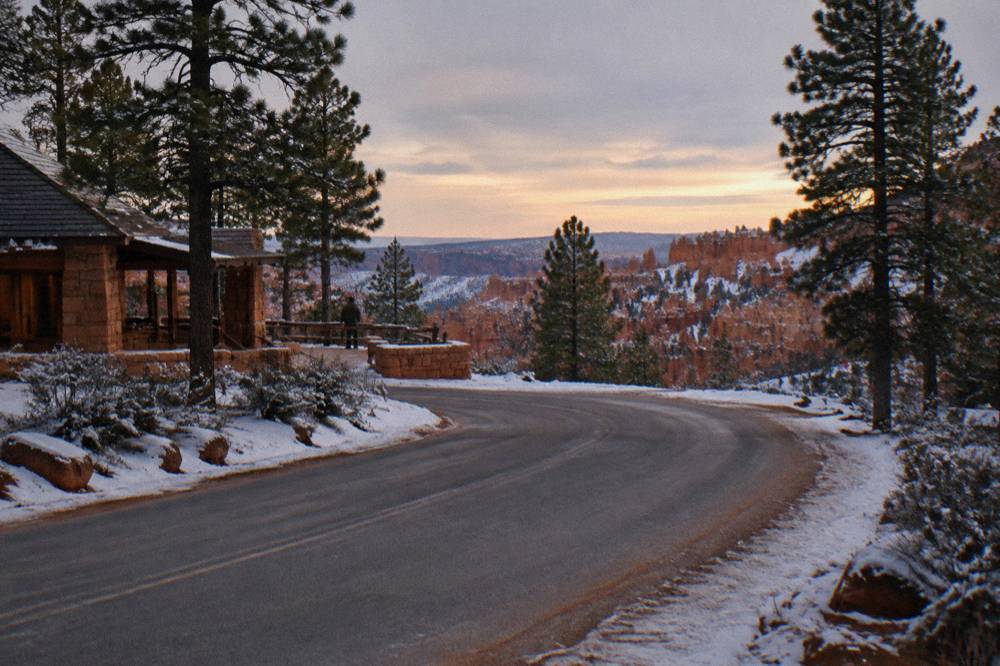
The trade-off is winter. After storms the main road can close temporarily at mile marker 3, the Rainbow Gate, so plows can clear the southern drive; those closures typically last a day or more, while the amphitheater's first 3 miles stay open because plowing prioritizes them. Fairyland Point Road and Paria View Road close to vehicles for the whole winter season, though you can still reach both on foot, skis or snowshoes.
Two drive formats suit non-hikers who want narration. A self-guided driving audio tour from Travel with Action costs from $16.99 per group of up to 4, holds a 4.3 rating across 89 reviews, and plays GPS-triggered stories offline as you pass the Bryce Amphitheater, the visitor center and Bryce Point; one purchase covers the car, and lifetime access lets you reuse it. The GuideAlong GyPSy Guide version, from $26.99 per group of up to 8 with 4.6 across 25 reviews, packs 195+ points into an app with suggested itineraries. Both leave entrance fees, parking and food separate.
Prefer someone else to drive? The question of guided wheels versus your own car is covered in detail in Bryce Canyon tour versus self-drive, and the short answer is that a guided minivan removes the parking gamble entirely in July and August. If you would rather absorb the rim from the saddle or the air than the driver's seat, the next two sections cover those.
Ride Horseback Through Red Canyon Near Bryce Canyon
Horseback riding is the classic non-hiking way to get among red rock. The listed option rides 3 hours through Red Canyon and Losee Canyon in Dixie National Forest from $130 per person, 4.7 across 252 reviews, departing Bryce Canyon City outside the national park. Inside the park, the concessioner Canyon Trail Rides runs 2-hour and 3-hour guided rides into the Amphitheater, typically April through October 31.
The distinction matters and is worth stating plainly: the Rubys Inn Adventures horseback tour listed on this site does not enter the national park, and that is not a hidden drawback, it is how land access works here. Red Canyon, a section of Dixie National Forest just a few minutes west of the park on Scenic Byway 12, delivers orange sandstone arches and stands of ponderosa pine that many visitors mistake for the park itself. The 3-hour ride includes the trail horse with saddle, saddlebags, a knowledgeable guide, basic riding instruction and a water bottle; gratuities are extra.
The listing includes what it includes, and riders should book with realistic expectations about the mount, the pace and the weather at 8,000 ft. Reviews at 4.7 across 252 reviews describe steady trail horses and guides who read the group well.
Inside the park, Canyon Trail Rides is the official concessioner, with rides that descend into the amphitheater on trails built for stock. Those rides are booked through the operator directly, within 7 days by phone, and dates are seasonal, weather permitting. Full pricing for both options, and the weight questions everyone asks, are covered in this site's guide to Bryce Canyon horseback rides.
Look Down On The Hoodoos: Helicopter Flights Over Bryce Canyon
Helicopter flights depart Bryce Canyon Airport and fly over the park's formations without landing in it, since park rules prohibit aircraft launching or landing inside the boundary. The listed 15-minute flight runs from $175 per person, and the 30-minute version from $309 per person; the longer flight covers roughly a 55-mile route past Rainbow Point and the Natural Bridge per the operator's description. Both include the preflight safety briefing and applicable 11.5% fees, with gratuity separate.
A flight is the one perspective the rim cannot give you: the amphitheater seen as a single carved basin, with the forested Paunsaugunt Plateau stretching to the horizon. The operator, Bryce Canyon Helicopters, flies from the airport just north of the park, and the listing states flights are subject to weight and balance limits and weather. That caveat is standard aviation honesty rather than fine print, and the site's hard rule on honesty applies here too: no operator can promise conditions, so book the time slot and let the sky decide. Everything else covered here is indexed on Bryce Canyon National Park Tours.
Review pools for the flights are small, 13 reviews at 3.7 for the 15-minute flight and 5 reviews at 5.0 for the 30-minute flight, and this site's policy is not to dress those numbers up as proven excellence either way. Treat the rating as a thin sample and weigh the route description and the price instead. What is verifiable: the flight paths, the durations, the airport departure point and the fee structure as the listings state them.
One related point from the same rulebook: drones are also prohibited within park boundaries, so leave yours at home or flown outside the park. Scenic flights, not personal aircraft, are the sanctioned way to see Bryce from above, and the full rundown lives in Bryce Canyon helicopter tours.
Stargazing Near Bryce Canyon Without Hiking
Yes, you can stargaze near Bryce Canyon without hiking: the park is a Gold Tier International Dark Sky Park, and guided 1.5-hour sessions at a private dark-sky site in Bryce Canyon City run from $59 per person (4.4 across 63 reviews) or $59.04 with hotel pickup (4.5 across 69 reviews), with telescopes, laser pointers, guides, and hot beverages. Inside the park, roughly 100 ranger astronomy programs run each year, free with admission.
The night sky here is not a bonus feature, it is half the park. The designation, awarded in 2019, recognizes skies dark enough that the Milky Way casts a shadow on moonless nights, and the park service says the best viewing falls in the week of or just before the new moon. Ranger programs concentrate in June and July, with telescope sessions typically Thursday through Saturday evenings at Sunset Point, weather permitting; ranger programs cancel when lightning is within 10 miles in summer or when wind chill drops to 10 F or below in winter.
The commercial sessions solve a problem the free programs do not: warmth and telescopes. A private site means chairs, blankets, restrooms and hot drinks rather than a cold overlook, and the guides aim the optics at whatever the season offers. The late-night session, from $106.28 per person with 9 reviews at 4.9, too few for a star claim on this site, runs after the family crowds have gone to bed. The basic session's optional shuttle from Ruby's Inn costs an extra $10 and is listed as an exclusion, not an inclusion.
One honesty note the site owes you: these stargazing sessions take place near Bryce Canyon City, and the listings do not claim the sessions happen inside the national park. The dark skies are the same skies; the land is not. If in-park night viewing matters to you, the ranger telescope programs at Sunset Point are the free, in-park route, and the annual four-day Astronomy Festival each summer, free with admission, adds daytime activities and constellation tours.
Ranger Programs And Easy Paved Paths At Bryce Canyon
Ranger programs are free with admission, posted at the visitor center, and mostly stationary: geology talks, evening astronomy sessions and kids' programs rather than forced marches. On the paved-path side, the Shared Use Path, a 24-mile route whose final 2.7-mile segment was completed in autumn 2026, now connects Red Canyon through the visitor center to the Sunrise, Sunset, Inspiration and Bryce Point area, open to walkers, cyclists and wheelchair users. Neither involves a trail descent.
The Shared Use Path completion is the freshest genuinely useful fact for non-hikers in this article. Construction ran from May 2025 to September 2026, and the park service announced the finished trail on October 15, 2026. It means you can now walk or roll between the amphitheater viewpoints, the campgrounds and the visitor center on a dedicated paved corridor, separated from the road, with a bike or on foot. Rentals, standard bikes and pedal-assist e-bikes of 750 watts or less, are available at the Historic Service Station in Bryce Canyon; e-bikes are legal on park roads and the path but not on the Rim Trail or overlooks.
Winter adds its own stationary pleasures. When snow depth and staffing allow, rangers lead snowshoe hikes with free snowshoes and poles for participants ages 8 and up, and winter full moon outings become snowshoe walks when snowpack passes 16 inches. Full Moon Hikes year-round run 1 to 2 miles over 2 to 3 hours on limited tickets, on flat terrain near the rim, with no flashlights allowed; the park announces the meeting location only to ticket holders. Cross-country skiing is permitted on designated routes above the rim, including unplowed sections.
A quiet budget note sits under all of this. The park's fee-free days in 2026 that remain are October 27 and November 11, and the free tier of a Bryce visit, viewpoints, shuttle, ranger programs, the path, is genuinely large. The site's guide to free things to do in Bryce Canyon walks the whole list, including the Rim Trail segments that need no entrance station at all when you arrive on foot or wheel.
Pair A Non-Hiking Day With A Guided Tour
If one day is all you have, the highest-yield non-hiking stack is a morning at the amphitheater overlooks, a midday drive of the southern scenic road with an audio tour, and an evening stargazing session. Las Vegas visitors can outsource the driving entirely: listed day trips pair Bryce and Zion in 12 to 14 hours from $219 per person. The 3-hour small group park tour from $84.81 per person is the simplest single guided purchase.
The Las Vegas connection deserves a sentence of honesty about distance: the airports at Las Vegas and Salt Lake City each sit about 270 miles from the park, so any day trip is a long one by design. The listed Bryce and Zion luxury boutique tour from National Park Express, from $219 per person with 4.7 across 1,224 reviews, runs 13 hours with hotel pickup, a deli-style lunch and WiFi on a Mercedes Sprinter. A parallel listing at from $234 per person, 4.7 across 2,711 reviews, includes park admission for US residents with valid ID. The 14-hour Adventure Photo Tours version, from $321.99 per person, 4.8 across 233 reviews, adds breakfast and a boxed lunch and stops at Bryce Point.
For multi-day ambition without hiking, three-day loops covering Grand Canyon, Bryce, Zion, Antelope Canyon and Monument Valley start from $590 per person on the budget Empire Vacations itinerary, 4.7 across 257 reviews, rising to from $799.99 per person on the MaxTour version with 5.0 across 614 reviews, which includes hotels, most meals and entrance fees. Bindlestiff runs a camping-flavored option from $875 per person, 4.8 across 462 reviews. These trips see the parks from overlooks and short walks; nobody signs you up for a rim descent.
| Experience | Where it runs | Listed price | Rating and reviews |
|---|---|---|---|
| Scenic Tour of Bryce Canyon (3 hours) | Inside the park, overlooks | from $84.81 per person | 4.9 across 1,215 reviews |
| Guided Sightseeing Tour (3 hours, fee included) | Inside the park, Fairyland start | from $109 per person | 4.9 across 945 reviews |
| Bryce Canyon Private Tour (3 hours) | Inside the park | from $159.95 per person | 5.0 across 35 reviews |
| Red Canyon horseback ride (3 hours) | Dixie National Forest, outside the park | from $130 per person | 4.7 across 252 reviews |
| 15-minute helicopter flight | Bryce Canyon Airport, over the park | from $175 per person | 3.7 across 13 reviews |
| Stargazing session (1.5 hours) | Private site, Bryce Canyon City | from $59 per person | 4.4 across 63 reviews |
| Audio driving tour | Self-drive, inside the park | from $16.99 per group of up to 4 | 4.3 across 89 reviews |
The private 3-hour park tour deserves its line in the table even for solo travelers reading this: at from $159.95 per person, 5.0 across 35 reviews, it is the same operator as the scenic tour with the van to yourselves, water and snacks included, park admission separate. For a fuller comparison of every guided option, see Bryce Canyon guided tours.
Whichever way you assemble the day, the pattern holds: the rim gives you the views, the road gives you the range, and the operators give you the legs. Whether that means a narrated drive in your own car, a saddle in Red Canyon, a seat over the amphitheater or a telescope under a Gold Tier sky, none of it asks you to hike.
Common Questions About Visiting Bryce Canyon Without Hiking
What To Do In Bryce Canyon If You Don't Hike?
Stay on the rim: the Sunrise, Sunset, Inspiration and Bryce Point overlooks all sit a short walk from parking. Drive or shuttle the 18-mile scenic road, take the 3-hour guided scenic tour from $84.81 per person, ride horseback through Red Canyon from $130, fly over the formations from Bryce Canyon Airport from $175, or join a stargazing session from $59 per person at a private dark-sky site near the park.
Can You Enjoy Bryce Canyon Without Hiking?
Yes. The park's defining views are from the rim, and every major amphitheater viewpoint is reached by a short walk from a parking area or shuttle stop. The free shuttle, ranger programs, the new 24-mile Shared Use Path and the southern scenic drive add up to two full days of activity without a trailhead.
What Is The Best Tour Of Bryce Canyon For Non-Hikers?
The 3-hour Scenic Tour of Bryce Canyon, from $84.81 per person with a 4.9 rating across 1,215 reviews, is the most direct fit: a small group minivan tour of the overlooks with water and snacks included. The version from $109 per person includes the park entrance fee and starts at Fairyland Canyon. Park admission is separate on the $84.81 listing.
Can You See The Hoodoos Without Hiking Down?
Completely. Because the amphitheater sits below the rim, you look down on the hoodoos from Sunrise, Sunset, Inspiration and Bryce Point. The park service notes that only the half-mile Rim Trail stretch between Sunset and Sunrise Points meets wheelchair standards, but every major viewpoint is a short, gentle walk from drop-off.
Are The Horseback Rides Inside Bryce Canyon National Park?
The listed 3-hour ride from $130 per person runs through Red Canyon and Losee Canyon in Dixie National Forest, outside the park boundary, with the same red rock scenery. Inside the park, the concessioner Canyon Trail Rides offers 2-hour and 3-hour guided rides into the Amphitheater, typically April through October 31, booked directly with the operator.
Can ATVs Or Helicopters Enter Bryce Canyon?
No. All off-highway vehicles are prohibited on park roads and areas, and aircraft may not launch or land inside the boundary. ATV tours listed on this site ride Dixie National Forest and private land near Bryce Canyon City from $145 per group of up to 2, and helicopter flights over the park depart from Bryce Canyon Airport.