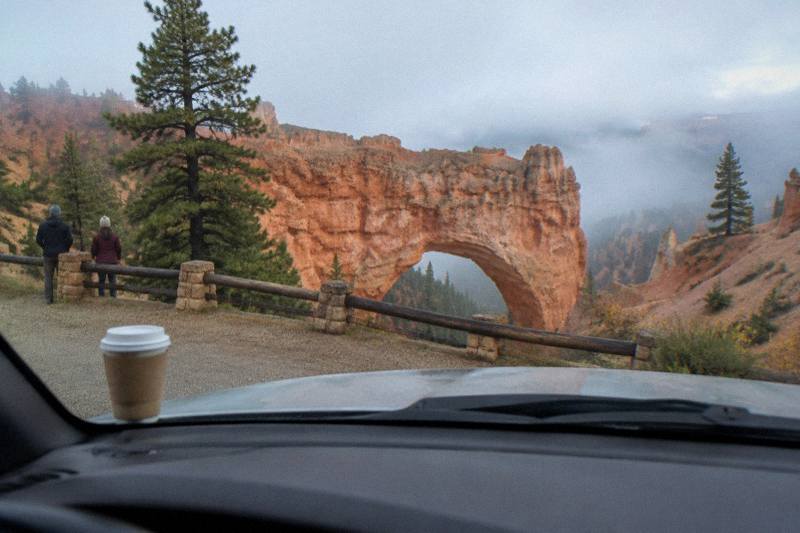
Can I Just Drive Through Bryce Canyon National Park?
Yes, you can drive through Bryce Canyon: the 18-mile scenic drive has no timed entry, and the first overlooks sit 3 miles in. Here is what a drive-through visit costs, takes and misses.
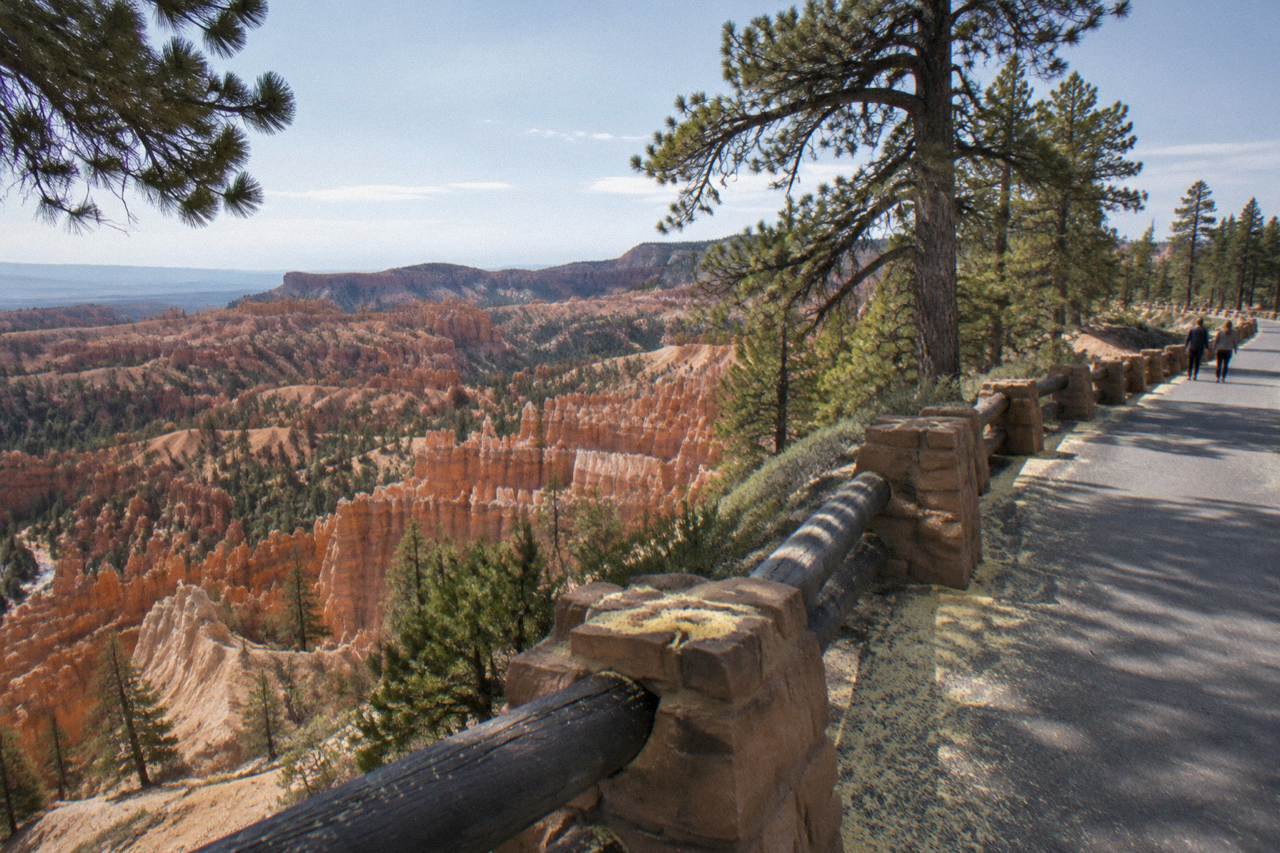
Yes. Bryce Canyon is open 24 hours a day, every day of the year, with no timed entry and no advance reservation, so anyone can pay at the gate and drive the 18-mile main road. The four most famous overlooks, Sunrise, Sunset, Inspiration and Bryce Point, all sit within the first 3 miles. A pure drive-through is legal, quick and genuinely scenic.
That is the short version. The longer version is that Bryce Canyon rewards getting out of the car, because the road runs along the rim and the amphitheater of hoodoos sits below it. From behind a windshield you see the tops of the formations. From the Queen's Garden trail, which the park service describes as the most recommended first hike, you stand among them. Nothing about the entrance system forces that choice, though. There is no shuttle requirement, no permit to enter and no minimum stay.
The gate fee is straightforward. A private vehicle carrying 15 passengers or fewer pays $35.00, valid for seven days. Motorcycles pay $30.00. Anyone entering on foot or by bicycle pays $20.00 per person age 16 and over, and children under 16 are free. The park does not take cash at fee stations, so bring a card or buy a digital pass ahead. Non-US residents age 16 and over pay an additional $100 per person nonresident fee unless they hold an Annual or America the Beautiful pass, and the park service states plainly that this applies even to people arriving inside a commercial tour group.
One point of honesty about the phrase "drive through": Bryce Canyon is a destination park, not a corridor. The main road dead-ends at Rainbow Point and you drive back out the same way, so you cannot pass through to another town on park pavement. If your trip plan is Las Vegas to Capitol Reef or Zion to Bryce in a single day, the park sits on a spur, and the spur is the whole point. Our Bryce Canyon National Park Tours coverage exists because many visitors decide the drive alone undersells the place.
Distances explain why so many people ask the question in the first place. Las Vegas and Salt Lake City airports each sit about 270 miles from the park, Zion's east entrance is 78 miles, and Capitol Reef is 112. Bryce Canyon is almost always one stop on a longer southern Utah loop, and a loop leaves limited hours. The drive-through question is really a time-budget question: can the park be sampled in ninety minutes between two longer legs of a road trip? The answer is yes, with eyes open about what gets skipped.
For drivers who want narration without a group, the self-guided audio driving tour from Travel with Action covers the scenic drive with GPS-triggered stories for from $16.99 per group, up to 4 people, one purchase covering the whole car. The small group scenic tour from Bryce Canyon Scenic Tours, from $84.81 per person, and the guided sightseeing tour with the park fee included, from $109 per person, are the step-up options if you would rather ride than read a map.
How Long Does A Drive-Through Of Bryce Canyon Take?
Count on two to three hours at a relaxed pace with photo stops, and as little as one hour if you only pause at the Amphitheater overlooks. The full scenic drive is 18 miles each way, and the park service notes the highest concentration of viewpoints sits in the first 3 miles. Adding Rainbow Point at the far end roughly doubles the driving distance for one extra overlook.
Those figures assume normal traffic and open roads. Midsummer days are the park's busiest, and the park service recommends its free shuttle specifically because parking at the popular overlooks fills. The shuttle is not mandatory, and driving yourself is entirely allowed, but the shuttle spares you the circling-for-a-space problem at Sunrise and Sunset Points. Buses run roughly every 15 minutes and board at the Shuttle Station in Bryce Canyon City or the Visitor Center.
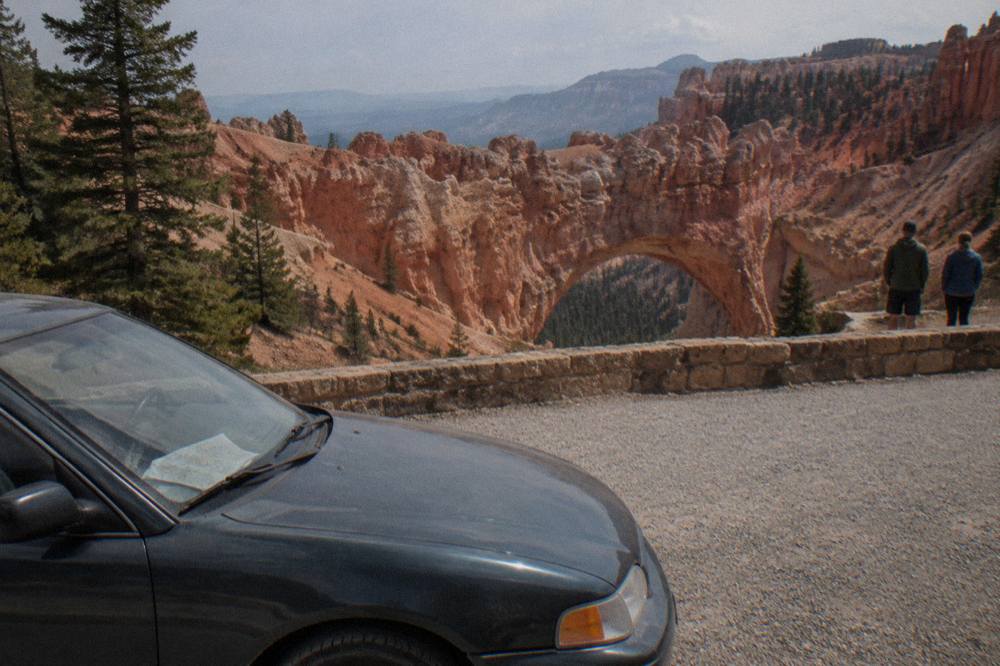
The rhythm of the drive matters as much as the stopwatch. Most drivers enter, stop at Sunrise Point, then work west along the rim to Sunset, Inspiration and Bryce Point, each a few minutes apart by car. From there the road turns south and the character changes: fewer people, longer views, forested stretches and the quiet overlooks at Ponderosa Point, Agua Canyon and Natural Bridge. A common compromise for time-pressed visitors is to drive the southern half first, while energy is high, and end at the Amphitheater overlooks closest to the exit, reversing the usual order and beating the midday crowds at both ends.
Drivers of long vehicles should plan around a specific rule: vehicles 23 feet or longer are restricted from Amphitheater-area parking, miles 1 to 3, during shuttle season. There is no such restriction on the Southern Scenic Drive from miles 4 to 18, so an RV can still reach Rainbow Point and the quieter southern overlooks. If you are arriving in a big rig or a rented camper van, that rule effectively routes your drive-through to the southern half of the park, with the shuttle as the way to see the Amphitheater.
The hour-by-hour choice also depends on season. The 2026 shuttle schedule ran April 3 to mid-October with hours stretching to 8 p.m. in peak summer, per the park's shuttle page. Outside that window the road is all yours, and the park stays open around the clock, which is why photographers show up before dawn in January. For help planning the loop itself, the guide to the Bryce Canyon scenic drive and map breaks down every overlook.
What You Actually See From The Road
The main road strings together rim overlooks, and the views are of the Bryce Amphitheater and the Pink Cliffs from above. Sunrise, Sunset, Inspiration and Bryce Point sit closest to the entrance. Farther south lie Natural Bridge, Agua Canyon, Ponderosa Point and finally Rainbow Point at over 9,000 feet, the highest viewpoint on the drive.
The trade-off built into the park's geography is that the hoodoos are below the rim. Every overlook is a balcony, not a window. The park service's own framing of the most recommended first-time route, the Queen's Garden and Navajo combination loop, exists precisely because the road alone leaves most of the scenery unseen. Descending even a short way on the Queen's Garden side from Sunrise Point puts you among the formations rather than above them.
There is also a closure to know about before you lace up: the Wall Street section of the Navajo Loop is closed until further notice per a park service alert, and that side of the trail closes for winter by default regardless. Nobody should plan a drive-and-stroll visit around Wall Street this year. Trail conditions, including mud after rains, are tracked on the park's current conditions page.
For travelers who genuinely cannot or do not want to hike, the drive is still a legitimate experience, and the overlooks are the equal of many parks' best views. The guide on what to do in Bryce Canyon without hiking covers the full menu, from stargazing sessions at a private dark-sky site near Bryce Canyon City, from $59 per person, to the 15-minute helicopter flight from Bryce Canyon Airport over the formations, from $175 per person.
What A Drive-Through Costs: Fees, Passes And The Nonresident Rule
A car pays $35.00 at the gate, good for seven days. Motorcycles pay $30.00 and walkers or cyclists $20.00 per person age 16 and over. Non-US residents age 16 and over also owe a $100 per person nonresident fee unless a pass covers them, and the $250 nonresident annual pass covers the holder plus up to three nonresident adults in a commercial tour group.
The nonresident rule deserves emphasis because it surprises international visitors, especially those on organized trips. The park service states that the fee applies to nonresidents entering individually or as part of commercial tour, CUA or concessioner groups. Some listings absorb entry costs: the guided sightseeing tour from Bryce Canyon Scenic Tours at from $109 per person includes the park entrance fee, while the 3-hour scenic tour at from $84.81 per person does not, listing admission as excluded.
| Entry type | Fee | Notes |
|---|---|---|
| Private vehicle, 15 passengers or fewer | $35.00 | Valid 7 days, all occupants |
| Motorcycle | $30.00 | 7 days, up to 2 motorcycles, 4 passengers |
| Per person, on foot or bicycle, age 16+ | $20.00 | Under 16 free |
| Nonresident surcharge, age 16+ | $100 per person | Applies unless covered by an Annual or America the Beautiful pass |
| America the Beautiful nonresident annual pass | $250 | Covers holder plus up to 3 nonresident adults in a commercial tour group |
The park is cashless at fee stations, which catches a few drivers every hour in summer. Commercial tour vehicles pay on a different schedule, mini-bus $60.00 and motor coach $150.00, valid the day of purchase plus six days, which is one reason tour prices vary so much in what they include. The full fee details sit on the park's fees page, and the deeper comparison, including fee-free days, is in our guide to Bryce Canyon entrance fees and passes.
For US residents, the America the Beautiful annual pass at $80 can pay for itself across a single southern Utah loop that also touches Zion, Capitol Reef or the Grand Canyon, all of which charge similar gate fees. The seven-day validity of the $35.00 Bryce receipt also means a drive-through today can legally become a second, slower visit tomorrow without paying again, a trick worth knowing if your road trip spends a night in Bryce Canyon City or Tropic.
Is Driving Yourself Better Than Taking A Tour?
Driving yourself is cheapest and most flexible, but you supply all the interpretation. An audio driving tour adds narration for from $16.99 per group, a guided 3-hour park tour costs from $84.81 or $109 per person depending on inclusions, and a Las Vegas small group day trip runs from $219 per person with transport and lunch. Each step up adds guidance, and removes your control of the clock.
This is the honest fork in the road for a drive-through visitor. The pure DIY approach costs the gate fee plus gasoline, and the park service's interpretive signage at the overlooks is genuinely good. What it lacks is story, geology, and the answer to "why do these exist," delivered while your eyes stay on the road.
| Option | Price | Duration | What you give up |
|---|---|---|---|
| Self-drive, no guide | Gate fee only | Your schedule | All narration and local knowledge |
| Self-guided audio driving tour | From $16.99 per group, up to 4 | 1 to 2 hours, self-paced | A live person to answer questions |
| Scenic Tour of Bryce Canyon, small group | From $84.81 per person | 3 hours | Your own wheel; park admission extra |
| Guided Sightseeing Tour, park fee included | From $109 per person | 3 hours | Your own wheel; starts at Fairyland Canyon |
| Vegas: Bryce and Zion luxury boutique tour | From $219 per person | 13 hours | The entire day, plus two park stops in one |
The audio option is the natural companion to a drive-through because it was built for exactly this road. The listing describes GPS-triggered stories that play automatically as you reach each stop, offline maps, lifetime access and one purchase covering everyone in the car. The GuideAlong audio tour covers both Zion and Bryce for from $26.99 per group of up to 8, if your drive-through is part of a two-park day. The deeper comparison of guided versus independent styles is in Bryce Canyon tour versus self-drive.
The 3-hour scenic tour, meanwhile, is the answer for drivers who do not want to drive. It runs at 4.9 across 1,215 reviews, meets at 450 N Arpt Rd near the park entrance, and includes bottled water and snacks, with park admission excluded. Its sister listing, the guided sightseeing tour, starts at Fairyland Canyon, visits Natural Bridge, Inspiration Point and the Cathedral, and folds the entrance fee into its from $109 per person price, running at 4.9 across 945 reviews. You can check the audio tour's availability or read the full write-up before deciding which direction suits your group.
Winter Driving: What Changes On The Road
Snow closes the main road at mile marker 3 after storms so plows can clear the southern drive, typically for a day or more, while the Amphitheater overlooks are plowed first and stay reachable. Fairyland Point and Paria View roads close to vehicles all winter. Average snowfall runs about 100 inches a year at park headquarters, with December through February snowiest.
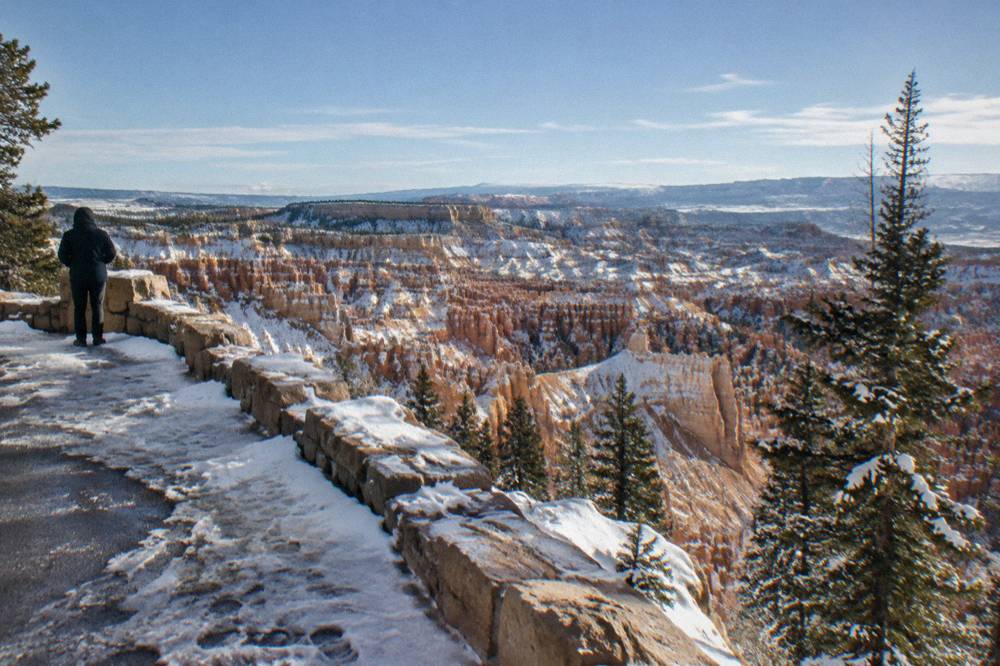
That means a winter drive-through is possible but partial. The park's winter guidance is explicit that closures are temporary and routine, not seasonal shutdowns, and the first 3 miles are prioritized because they carry the famous overlooks. Visitors arriving between November and March should check alerts the morning of the drive, and expect the Fairyland and Paria spurs to be foot, ski or snowshoe access only.
Cold is the other constant. The park's weather table puts January average highs at 37 F with lows of 15 F, and nights dip below freezing nearly every night from October through May. The flip side is that winter transforms the drive: red hoodoos under snow, cross-country skiing on the unplowed spur roads, and full moon snowshoe hikes when snowpack exceeds 16 inches. The park service publishes its full winter road guidance at its winter page, and our Bryce Canyon winter tours guide covers what still runs in the cold months.
Snow statistics tell you how likely a closure really is. Historical averages at the headquarters area run 17 inches in January, 18 in February, 17 in March and 8 in April, with 10 in November and 14 in December. October snowstorms are described by the park service as not unusual, so even a late-autumn drive-through should carry chains or winter tires and a backup plan. The ranger programs that might have drawn you to linger are cancelled when lightning comes within 10 miles in summer or when windchill hits 10 F or below in winter, so a bad-weather drive-through may genuinely be the only show in town that day.
One Practical Way To Plan The Drive
Enter at the fee station, drive the first 3 miles to Sunrise, Sunset, Inspiration and Bryce Point, then decide: turn back after an hour, or continue the full 18 miles to Rainbow Point at over 9,000 feet. Arrive at Inspiration Point or Paria View about 1.5 hours before sunset for the best light, per the park service, and skip the shuttle entirely outside mid-April to mid-October.
The park's own advice anchors the timing. Sunrise belongs to Sunrise Point and Bryce Point. Sunset belongs to Inspiration Point or Paria View, with the 1.5-hour-early arrival recommended partly because parking thins and partly because the low sun does the stone work. Paria View faces west and is one of the quieter spots on the drive, reached by the same 0.3-mile spur road that closes each winter.
There is now a car-free string to the bow as well. The final 2.7-mile segment of the Shared Use Path, the paved Canyon2Canyon Trail from Red Canyon to the Bryce Point area, was completed in autumn 2026, connecting the Visitor Center, the main overlooks and the campgrounds on a 24-mile route. Bicycles and low-speed pedal-assist e-bikes are allowed on park roads and that path only, not on trails, which matters if your drive-through includes a bike rack.
Altitude deserves one sentence of respect before you plan anything ambitious. Elevations average about 8,000 feet and reach 9,115 feet at the top of the park, where effective oxygen is roughly 75 percent of sea level. Trails here start with a descent, which means every return climb is uphill at elevation, and the park service recommends drinking about a quart of water every one to two hours of activity. Even a short walk down from Sunrise Point is harder coming back up than it looks, which is the quiet argument for budgeting more than a bare drive-through if your body allows it.
Finally, do not treat the drive as a box checked. The park service estimates roughly 100 astronomy programs a year, this is a Gold Tier International Dark Sky Park, and the same road you drove at noon becomes one of the best night-sky corridors in the country after dark. Guided stargazing sessions run from $59 per person at a private dark-sky site near Bryce Canyon City, telescopes included, and pair naturally with an evening arrival.
Common Questions About Driving Through Bryce Canyon
Can I Just Drive Through Bryce Canyon National Park?
Yes. The park is open 24 hours a day year-round with no timed entry or reservation. Pay the $35.00 private vehicle fee and drive the 18-mile main road; the four main Amphitheater overlooks sit within the first 3 miles.
How Long Does It Take To Drive Through Bryce Canyon?
About two to three hours with photo stops at a relaxed pace, or as little as one hour if you only visit the Amphitheater overlooks in the first 3 miles. Driving to Rainbow Point and back covers the full 18 miles each way.
Do I Have To Take The Shuttle Instead Of Driving?
No, the shuttle is optional. The park service recommends it in the busy season because overlook parking fills, and buses run about every 15 minutes from Bryce Canyon City and the Visitor Center, but driving the scenic road yourself is allowed all year.
Can An RV Or Oversize Vehicle Drive Through The Park?
Vehicles 23 feet or longer are restricted from Amphitheater-area parking, miles 1 to 3, during shuttle season. The Southern Scenic Drive, miles 4 to 18, has no such restriction, so oversize vehicles can still reach the southern overlooks and Rainbow Point.
Does The Park Road Ever Close?
After winter storms the main road closes temporarily at mile marker 3 so plows can clear the southern drive, typically for a day or more, while the Amphitheater area stays accessible. Fairyland Point and Paria View roads close to vehicles for the entire winter season.
Is The Drive-Through Worth It Without Hiking?
For many visitors, yes: the rim overlooks are among the most accessible famous views in the national park system. An audio driving tour at from $16.99 per group adds narration, and guided 3-hour tours from $84.81 per person add a live guide without requiring any hiking.