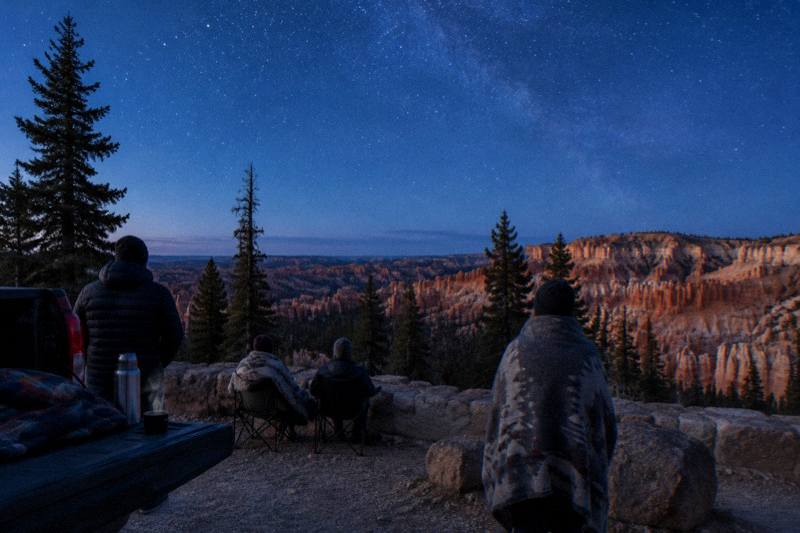
Bryce Canyon Stargazing: Dark Sky Tours And Free Ranger Programs
Bryce Canyon holds a Gold Tier International Dark Sky Park designation, and roughly 100 ranger-led astronomy programs run there each year. This guide separates the free park programs from the bookable telescope sessions at Bryce Canyon City, and explains how the moon decides what you will see.
Short answer
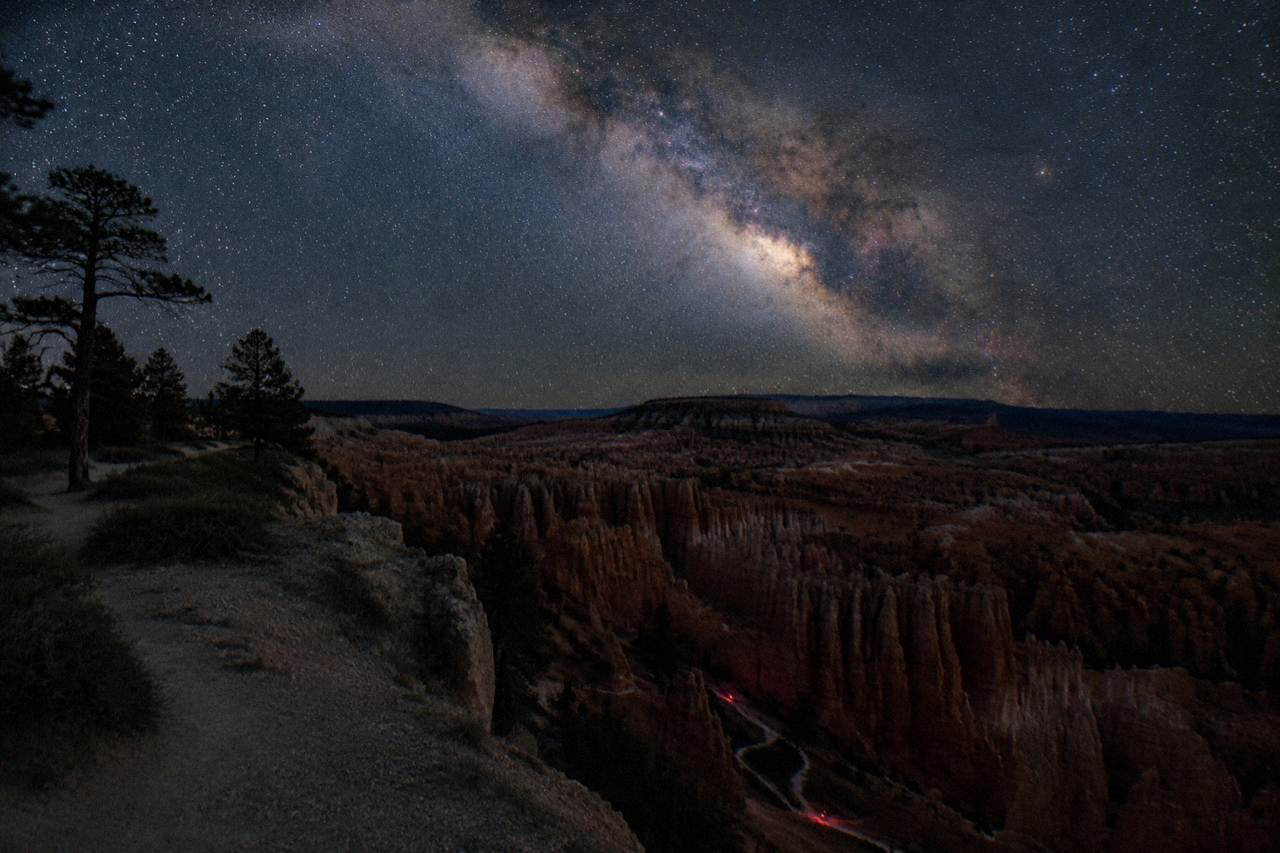
Bryce Canyon is an International Dark Sky Park with Gold Tier designation, awarded in 2019. Free ranger programs run about 100 times a year, best near the new moon. Bookable guided sessions cost from $59.04 to $106.28 per person and run at a private dark-sky site at Bryce Canyon City, not inside the park.
High, dry and remote, the Paunsaugunt Plateau sits far from the light domes of any major city, and the park service has protected what is left of its night sky. Bryce Canyon earned International Dark Sky Park status with a Gold Tier designation in 2019, the strictest tier the International Dark-Sky Association awards. The park runs roughly 100 astronomy programs a year, and a cluster of commercial stargazing sessions operates just outside the boundary at Bryce Canyon City. This guide lays out both worlds: the free ranger programming inside the park, and the bookable telescope tours nearby, plus the single variable that matters more than any of them, the phase of the moon.
Before the details, one honest framing. Every guided stargazing session runs at a private dark-sky site at Bryce Canyon City, a short drive from the park entrance. They are not inside the national park, and no operator can promise what the sky will do on any given night. What a listing can tell you is what equipment, guidance and shelter from headlights it provides.
Why Is Bryce Canyon Such A Good Stargazing Destination?
Bryce Canyon is a Gold Tier International Dark Sky Park, a designation it received in 2019, which places it in the strictest tier of dark sky protection worldwide. The park service runs about 100 astronomy programs a year, more than almost any other unit of the national park system, and the thin, dry air at 8,000 to 9,115 feet of elevation helps stars appear steady and bright. Clean air and distance from cities do the rest.
The elevation figures matter more than most visitors expect. The park averages about 8,000 feet and reaches 9,115 feet at its high points, and at 8,000 feet the effective oxygen level is roughly 75 percent of sea level. Less atmosphere sits between your eye and the stars, and the desert air carries little of the moisture that dims and blurs them at lower elevations. The park service describes the result on its night sky pages: on a clear night near the new moon, the Milky Way is visible to the naked eye, and thousands of fainter stars appear that city dwellers never see.
That clarity is also defended by policy. The park has retrofitted its lighting, hosts an annual four-day Astronomy Festival around the June new moon, and staffs a dedicated astronomy ranger team. The 2026 festival ran June 11 to 13 with daytime activities, evening programs, telescope viewing and constellation tours, free with park admission. The park service has not yet published 2027 festival dates, so treat the June new moon pattern as the planning signal rather than a fixed calendar entry. If you are weighing the whole calendar, the best time for Bryce Canyon tours guide covers the month-by-month tradeoffs.
A short note on honesty, because this article will not promise you a sky. Cloud cover, smoke and monsoon thunderstorms vary night to night. July and August bring frequent afternoon storms that can leave evenings hazy, while autumn nights are often clearer but cold. What you can control is the date you pick and the program you join.
Where Do The Guided Stargazing Tours Actually Take Place?
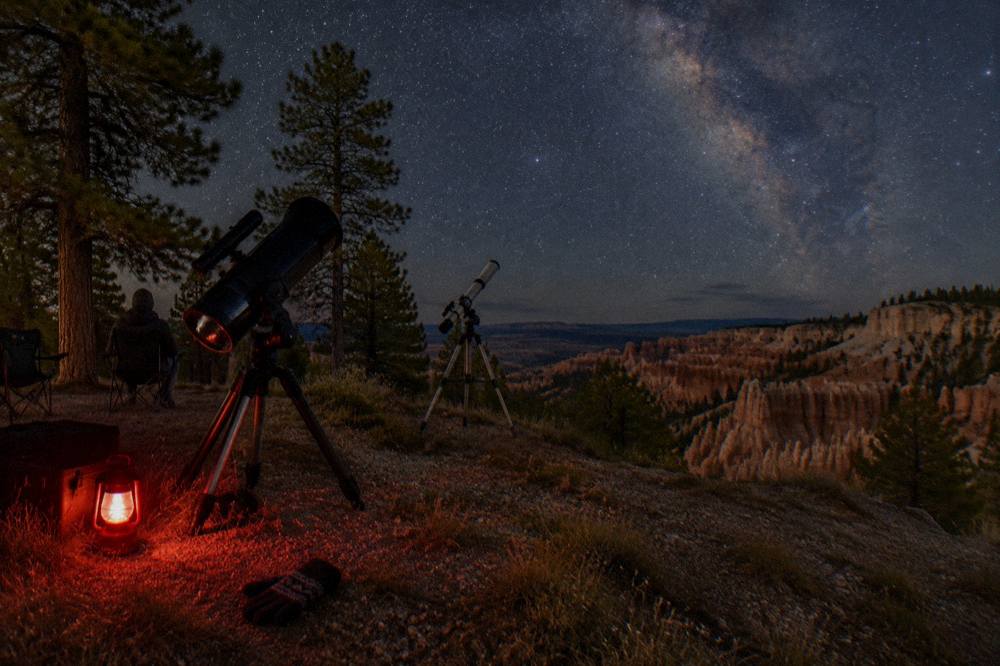
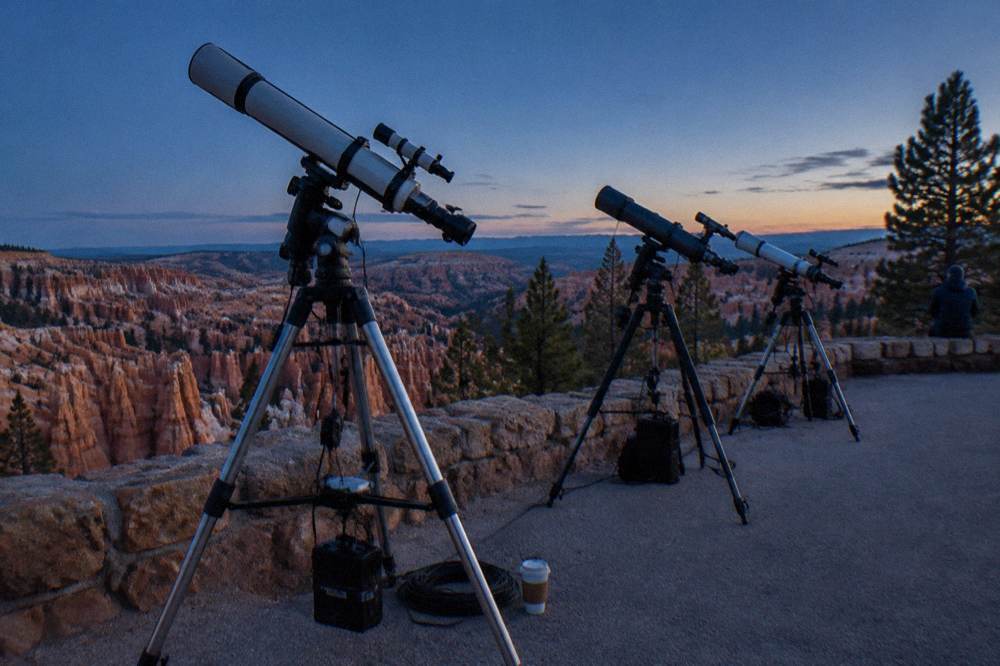
Every stargazing session you can book here runs at a private dark-sky site at or near Bryce Canyon City, on the highway corridor outside the national park entrance, not inside the park boundary. The operators list telescopes, laser pointers, chairs, blankets, restrooms and hot beverages on site, so the experience is built for comfort over a long stretch of night. Sessions last an hour and a half.
This is the detail first-time visitors most often get wrong. The three guided sessions, the standard stargazing adventure, the stargazing experience, and a late-night session, are all run by the same Bryce Canyon City stargazing operator at a permanent private site chosen for its darkness. The listings describe high-powered telescopes, laser pointers used to trace constellations, knowledgeable guides, chairs and blankets, and hot beverages. One listing notes an optional shuttle from Ruby's Inn for an extra $10.
The park itself does not contract these commercial sessions. Inside the boundary, the park service's own astronomy programs, telescopes at Sunset Point and full moon hikes, are the free, ranger-led alternative. Neither option is fake darkness: Bryce Canyon City sits close enough to the park that its private sites still enjoy the Gold Tier region's sky. But if a listing tells you a tour happens "in Bryce Canyon," read the fine print, because the commercial sessions are honest about being at a private site nearby.
A comparison of the three bookable sessions, using only what each listing states:
| Session | Price | Duration | Reviews | Pickup | Included |
|---|---|---|---|---|---|
| Stargazing Adventure | from $59.04 per person | 1 hour 30 minutes | 4.5 across 69 reviews | hotel pickup listed | coffee and/or tea |
| Stargazing Experience | from $59 per person | 1.5 hours | 4.4 across 63 reviews | not listed; optional shuttle from Ruby's Inn $10 | telescopes, laser pointers, chairs, blankets, hot beverages, restrooms |
| Late Night Stargazing | from $106.28 per person | 1 hour 30 minutes | 9 reviews so far, too few to judge by | hotel pickup listed | hot chocolate, tea or coffee |
The stargazing experience at $59 is the most equipped on paper, with the longest list of on-site comforts, while the adventure at $59.04 adds hotel pickup. The late-night session costs nearly double, and while its nine reviews reflect genuine guest feedback, that is a small sample to judge by. Its pitch is simply a later window under a darker, post-crowd sky.
All three listings show free cancellation, so the practical strategy is to book the window that suits your energy level and check the operator's live listing for the exact meeting details. The standard session is the one this site features most often, and you can read the full rundown on the Bryce Canyon stargazing adventure page.
Which Bryce Canyon Stargazing Option Fits Your Trip?
Pick the paid telescope session if you want equipment, a guide, and a set schedule for around $59 per person, and pick the free ranger programs if your dates match their summer lineup and you prefer the in-park setting. Families with young kids lean toward the hour-and-a-half commercial session, dedicated astrophotographers time trips to the new moon week and add the free programs as a bonus, and anyone with two nights can simply stack both.
The decision usually comes down to three variables: your dates, your budget and how much structure you want. The ranger programs inside the park are concentrated in the June-through-July window, with telescope programs generally offered Thursdays, Fridays and Saturdays starting around 9:45 p.m. at Sunset Point, running 60 to 75 minutes and weather-dependent. If your trip falls outside that window, the commercial sessions at Bryce Canyon City may be the only guided option running.
Costs across the whole night-sky and near-sky menu, as each listing states them:
| Option | Cost | Who runs it | Where |
|---|---|---|---|
| Ranger telescope programs | free with park admission ($35 per private vehicle) | NPS | Sunset Point, inside the park |
| Full Moon Hike | free, limited tickets via Recreation.gov | NPS | location announced to ticket holders only |
| Stargazing Adventure | from $59.04 per person | Bryce Canyon City operator | private dark-sky site, Bryce Canyon City |
| Astronomy Festival | free with park admission, 4 days each June | NPS | inside the park |
Notice the entrance fee line. Park admission is $35 per private vehicle for 15 passengers or fewer, and non-US residents age 16 and over pay an additional $100 per person nonresident fee unless covered by an eligible pass. The commercial stargazing listings do not include park admission, but since the sessions run outside the boundary, stargazing-only visitors driving their own car may not need to enter the park at all that evening. The fee mechanics are laid out in the Bryce Canyon entrance fees and passes guide.
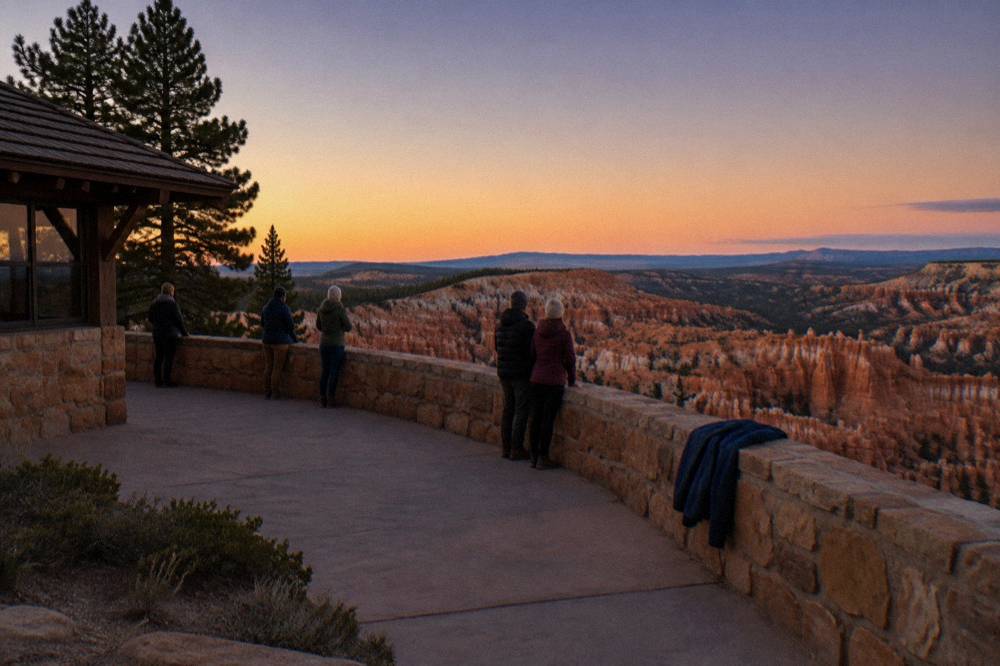
One more planning angle: the stargazing sessions pair naturally with a daytime product, and the roster gives you a clean one-two. The UTV sunset and stars tour with s'mores runs 2 hours 30 minutes from $149 per person, rated 4.9 across 36 reviews, and its listing names Bryce Canyon National Park as an itinerary stop while the ride itself stays on roads and routes open to such vehicles. A sunset ride that rolls into a dark-sky session is the fullest single evening the area offers.
What Are The Free NPS Astronomy Programs At Bryce Canyon?
The park service runs about 100 astronomy programs a year, and they are free with park admission. The core schedule is the Night Sky Telescope Program, generally Thursdays, Fridays and Saturdays from June through July, starting around 9:45 p.m. at Sunset Point and lasting 60 to 75 minutes, plus Full Moon Hikes on nights near each full moon. All programs are weather-dependent.
The telescope programs are the easiest free entry point. Rangers set up scopes at Sunset Point, one of the Amphitheater overlooks, and the park service posts the current ranger program schedule at the Visitor Center. Arrive early enough to find parking, bring a layer, and expect the program to be cancelled if lightning is within 10 miles, which is the stated summer cutoff, or if winter conditions bring snowstorms or windchill of 10 degrees Fahrenheit and below.
Full Moon Hikes are the other flagship. They run 1 to 2 miles over 2 to 3 hours, on or near full moon nights, with limited tickets released in phases through Recreation.gov and pickup required in person. The listing details are strict by design: hikers must be 8 or older, lug-soled or lug-traction footwear is required, flashlights are not allowed, and the meeting location is announced only to ticket holders. When snowpack exceeds 16 inches, the winter version becomes a snowshoe hike, with free snowshoes and poles provided on the ranger-led snowshoe program when depth and staffing allow.
The annual rhythm, as the park service describes it:
| Program | When | Details |
|---|---|---|
| Night Sky Telescope Program | Thursdays to Saturdays, June and July, about 9:45 p.m. | 60 to 75 minutes at Sunset Point, weather-dependent |
| Full Moon Hikes | on or near full moon nights, year-round | 1 to 2 miles, ages 8+, limited tickets, no flashlights |
| Astronomy Festival | 4 days each summer around the June new moon | free with admission; 2026 ran June 11 to 13 |
| Geology Festival | July | talks and exhibits at the Visitor Center and Lodge; 2026 ran July 17 to 18 |
The park service's own advice on timing is the single most useful line in its astronomy pages: the best stargazing comes during the week of, or prior to, the new moon. That applies to the paid sessions too. A telescope cannot subtract moonlight from the sky, so booking a commercial session on a bright weekend wastes the money as surely as skipping the free program would.
How Does The Moon Phase Change Your Stargazing At Bryce Canyon?
Near the new moon, the sky over Bryce Canyon is at its darkest and faint objects like the Milky Way's structure are most visible; near the full moon, the moon itself becomes the show and faint stars wash out. The park service explicitly recommends the week of or prior to the new moon for the best stargazing, and it schedules its Astronomy Festival around the June new moon for exactly this reason.
The moon is a giant natural floodlight, and when it is more than half illuminated, it raises the sky's background glow enough to erase most deep-sky objects from naked-eye view. The practical planning calendar works in four-week cycles. Roughly one week per cycle is genuinely dark, centered on the new moon, and one week is moon-dominated, centered on the full moon. A stargazing trip booked blind to the calendar has roughly a one-in-four chance of landing in the prime window.

There is a counterargument worth hearing. Full moon nights at Bryce Canyon have their own following, because the moonlit hoodoos of the Amphitheater glow in a way daylight never produces, and the Full Moon Hike exists to show exactly that. If your interest is landscape drama rather than deep-sky faintness, a full moon date plus a ticket to the ranger hike may beat a new moon date with nothing scheduled. The stargazing comparison between parks in is Bryce or Zion better for stargazing covers how Bryce's elevation and dryness give it the edge.
A simple decision matrix:
| If you want to see... | Best moon phase | Best product |
|---|---|---|
| Milky Way and faint stars | new moon week | any session, or Sunset Point on your own |
| Moonlit hoodoo landscape | nights near full moon | Full Moon Hike (limited tickets) |
| Planets and the moon through a scope | any clear night | guided session with telescopes |
| A festival atmosphere | June new moon | Astronomy Festival, free with admission |
None of this is a promise of clarity. Even a perfect new moon date can cloud over, and the monsoon season of July and August can push storms into the evening. Book cancellable products, keep a backup night, and treat any operator's clear-sky language as a description of the site, not a guarantee of the sky.
What Should You Bring For A Stargazing Night At Bryce Canyon?
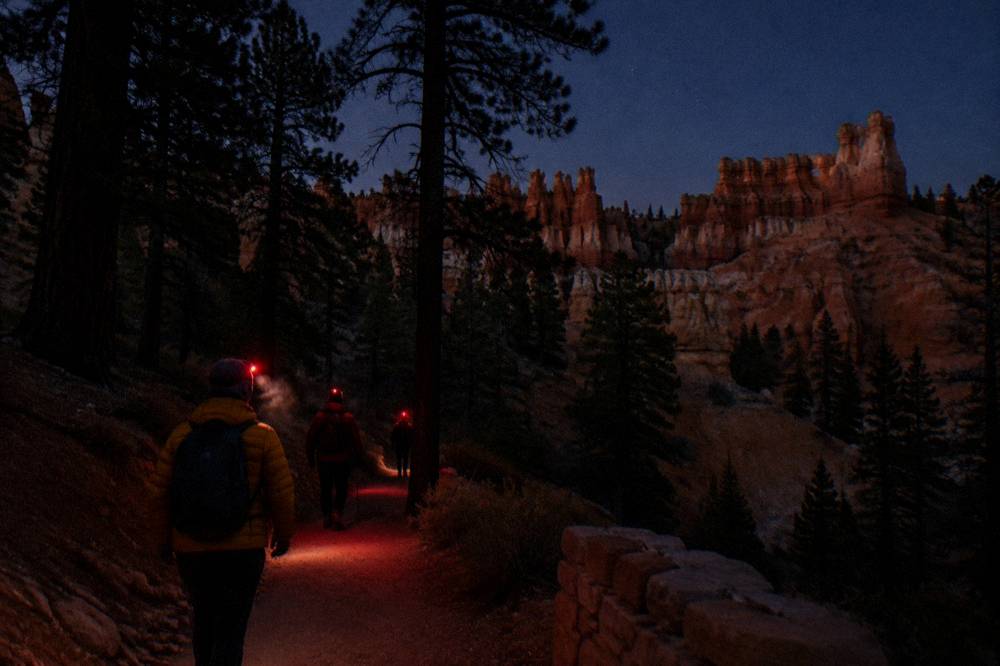
Bring serious layers, red-light headlamps if you have them, water, and closed shoes, because night temperatures at 8,000 feet drop fast even in summer, and the listings for the commercial sessions mention chairs, blankets and hot drinks because guests need them. For ranger programs, the park requires lug-traction footwear on Full Moon Hikes and prohibits flashlights entirely.
The altitude that sharpens the stars also chills the nights. Summer lows at the park average in the 50s Fahrenheit in July and August, the 40s in June and September, and near or below freezing from October onward; the park service notes below-freezing nights nearly every night from October through May. A stargazing session is an hour and a half of standing or sitting still, which is a different thermal problem from a daytime hike. The operators supply blankets, chairs and hot beverages at the private site for this reason.
A packing list that matches what the listings and the park service actually specify:
| Item | Why | Source |
|---|---|---|
| Insulated layers and a hat | still-body cold at 8,000 feet, freezes possible October to May | NPS weather data |
| Red-light headlamp | preserves night vision walking to and from sessions | standard dark-sky practice; listings do not ban it |
| Water | about 1 quart per 1 to 2 hours of activity at altitude | NPS day-hike guidance |
| Lug-traction footwear | required on Full Moon Hikes | NPS program rules |
| No flashlight | prohibited on Full Moon Hikes | NPS program rules |
| Booking confirmation | meeting point details vary by listing | operator listings |
Altitude deserves one more sentence. Effective oxygen at 8,000 feet is about 75 percent of sea level, and visitors arriving from low elevation on the same day sometimes feel it. Take the daylight hours easy, hydrate, and the night session becomes a pleasure instead of a headache.
If you would rather not end the trip when the sun sets, the area offers a daytime counterpart worth booking ahead. The Red Canyon horseback ride, 3 hours from $130 per person and rated 4.7 across 252 reviews, runs through Dixie National Forest outside the park, and a morning in the saddle plus an evening under telescopes makes a full plateau day. The mechanics of that ride are covered in the Bryce Canyon horseback rides guide.
Can You Combine Stargazing With Other Bryce Canyon Tours?
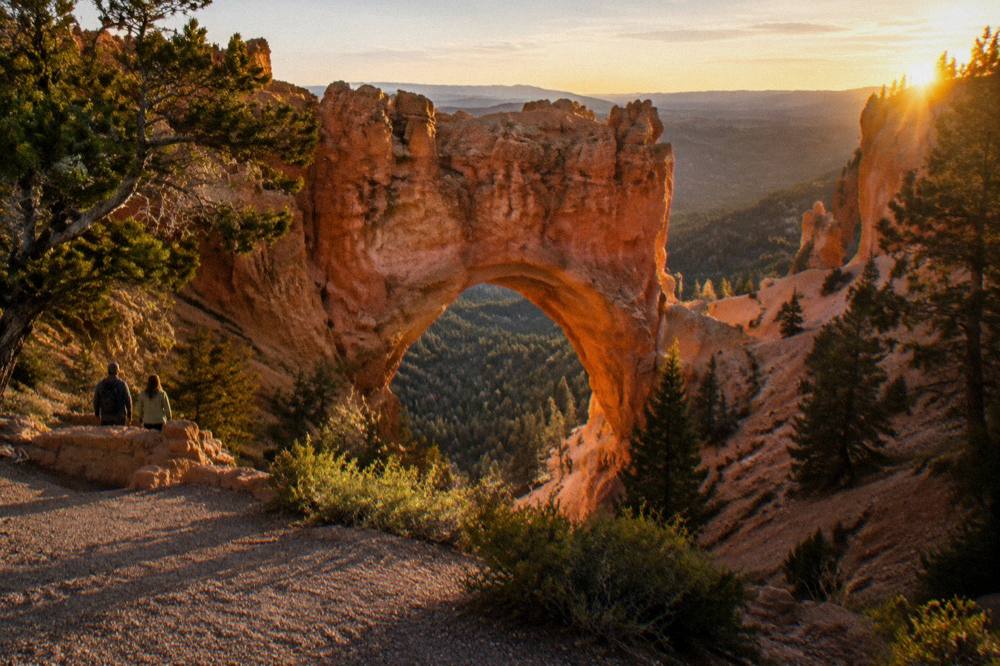
Yes, and the combination most visitors land on is a daytime park tour followed by an evening stargazing session, since the sessions start after dark and the park's prime viewpoints are best in daylight. The 3-hour guided sightseeing tour from $109 per person, rated 4.9 across 945 reviews, includes the park entrance fee and visits Fairyland Canyon, Natural Bridge, Inspiration Point and the Cathedral, making it a clean daytime anchor for a night session.
The economics favor this pairing. The guided sightseeing tour's listing includes the Bryce Canyon National Park entrance fee in its price, water and snacks, transport by minivan and umbrellas if needed, so one booking covers both your park entry and your orientation to the Amphitheater. Finish by late afternoon, eat in Bryce Canyon City, and roll into an hour-and-a-half telescope session at night. That is a complete Bryce day without driving the scenic road yourself twice.
The broader roster supports other stacks. The Las Vegas day trips, such as the 13-hour Bryce and Zion small group tour from $219 per person, return to the city at night, so stargazing suits the overnight and multi-day travelers more than the day-trippers. For trip budgeting across all of these, the Bryce Canyon tour prices guide breaks down what each product type costs and which fees are included.
For readers comparing the whole sky-and-scope menu side by side, here are the three bookable sessions once more, alongside their key differences.
Bryce Canyon rewards a planned night more than almost any park in the country, and the planning is not complicated: pick a new moon week if you can, book a cancellable session or note the free program schedule, and dress for a plateau at 8,000 feet after sundown. Whether you arrive through Bryce Canyon National Park Tours for the full roster or start with a single evening, the sky over the Paunsaugunt is the same one the park service works about a hundred nights a year to share.
Common Questions About Bryce Canyon Stargazing
Why Is Bryce Canyon Such A Good Stargazing Destination?
It is a Gold Tier International Dark Sky Park, designated in 2019, with elevations of 8,000 to 9,115 feet, dry desert air and distance from city light domes. The park runs about 100 astronomy programs a year.
Do The Guided Stargazing Tours Go Inside Bryce Canyon National Park?
No. The bookable sessions run at a private dark-sky site at Bryce Canyon City, outside the park boundary. They list telescopes, laser pointers, chairs, blankets, restrooms and hot beverages on site.
How Much Does A Bryce Canyon Stargazing Tour Cost?
The standard session is from $59.04 per person, the stargazing experience from $59 per person, and the late-night session from $106.28 per person. All run about an hour and a half and list free cancellation.
Are The NPS Astronomy Programs Free?
Yes, they are free with park admission, which is $35 per private vehicle. Telescope programs generally run Thursdays to Saturdays in June and July from about 9:45 p.m. at Sunset Point, weather-dependent.
When Is The Best Time To Go Stargazing At Bryce Canyon?
The park service recommends the week of or prior to the new moon. The annual Astronomy Festival is timed around the June new moon, and the 2026 edition ran June 11 to 13.
Can Children Join A Stargazing Session?
The commercial sessions do not state an age limit on their listings. The NPS Full Moon Hike requires ages 8 and up, and the ranger-led snowshoe program also lists ages 8 and up.